



Raccoons · At a glance
Sharing our city.
Not your attic.
Intelligent, strong and resourceful, raccoons look for warm, dry and quiet places to raise their young. Attics, chimneys, crawl spaces and sheltered areas under decks can become inviting den sites.
Our family-run team brings 40+ years of hands-on experience to humane raccoon removal across Toronto and the GTA.

Where they live
Attics, chimneys, roofs, crawl spaces, and under decks or sheds.
How they get in
Roof vents, existing openings, or weakened soffits, flashing, shingles and siding.
Signs & damage
Heavy nighttime movement, torn roof materials and disturbed insulation.
There may be babies
One adult coming and going can be a mother with a hidden litter inside.
See our procedures
Humane removal.
See it in action.
Watch how our team approaches raccoon removal from attics, chimneys and sheltered spaces, with care for the animals and your home.
Compassion is not negotiable
Raccoons in attics.
A humane way forward.
Every animal deserves to be treated with care. When a raccoon finds shelter in a home, we look for the safest way to help the family move on together, especially when young may be hidden nearby. We take the time to understand where they are and what they need before choosing a humane approach. Compassion guides every step.
Our team uses one-way doors, heated reunion boxes, and cellular monitoring to help keep mothers and babies together while protecting your home. Raccoons are living beings adapting to a shared city. We respect them as we make your space safe again.
If you’re experiencing a raccoon problem in your attic or home, it’s crucial to act fast to prevent damage and health risks. Raccoons can cause significant damage to structures and pose health concerns due to disease transmission through their feces. To address these issues, consider consulting Gates Wildlife Control, experts in animal control and raccoon removal with 40+ years of experience. Gates experts offer free on-site inspections, humane removal services, and animal-proofing solutions, including repairs and installations of galvanized screens. We ensure raccoons and other wildlife don’t return to your property.
Your raccoon resource
Answers, all in one place.
Explore the facts, understand potential damage, and find answers to common questions without leaving this page.
Raccoon Facts
Everything You Need To Know About Raccoons
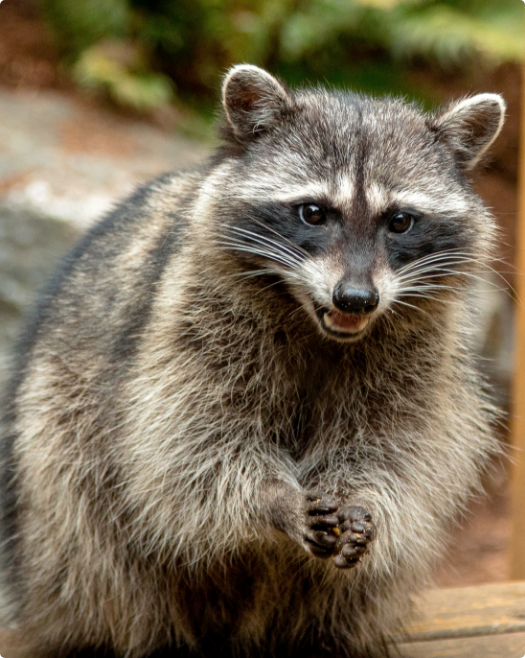
Raccoons, aka “masked bandits”, are revered for their intelligence and ingenuity. They have very nimble and manipulative paws and are very strong. These characteristics provide them with the necessary tools to damage and destroy property in their efforts to survive in urban environments. The following are some more raccoon facts and raccoon information for Toronto homeowners:
Habitat
Urban: Although the wild raccoon lives a largely solitary life, the attraction to urban areas can cause them to much more densely populate. A density of 10, 25 raccoons per square kilometer has been observed. They will build their dens in chimneys, attics, roofs, crawl spaces, under decks and sheds.
Breeding
Once per year: Male raccoons will attempt to mate with multiple partners each season whereas the female will mate with only one male, avoiding all others afterwards. Mating occurs during the winter months but can continue until June. This prolonged mating season makes it essential for wildlife technicians to detect if there are any babies present during the initial assessment. Offspring are born about 9 weeks after mating. It is not uncommon for mothers to make a last minute den to give birth in which is why urban structures are so attractive.
Litter size: The gestation period is around 63 days. Female raccoons produce litters between 1 and 7 offspring (typically 3 or 4).
Rearing: Newborn raccoons are blind and deaf for their first three weeks but grow quickly. They are cared for exclusively by the female who teaches them how to forage for food and shelter. One of the main threats to young raccoons is predators such as the coyote. Young raccoons will typically stay with their mother through the first winter after which they gradually leave..
Sexual maturity: Female raccoons can begin to breed at one year of age whereas males tend to begin later at the age of two.
Food And Feeding
Frequency: Raccoons feeds every day but must forage to locate their food.
Time of day: Raccoons are nocturnal so are most active at night.
Diet: They are omnivores which means they will eat both plants and animals as a primary food source. They prefer veggies, fruits, insects, slugs, snails, fish, frogs, turtles, small animals, eggs and are especially attracted to anything that is left behind in the garbage. They enjoy washing their food prior to eating which is where their latin name comes from, lotor means “one who washes”.
Morphology And Lifestyle
Body length: 18-30 in
Tail length: 8, 13 in
Weight: Average of 25lbs but up to 46 lbs
Habitat: Warm, dry and quiet spaces
Call: Raccoons can emit a large number of whimpers, churrs, snarls and squeals
Lifespan: 10 or more years in the wild
Did You Know?
Raccoon fact: The raccoon has very dexterous paws and are intelligent enough to twist handles and open doors.
Raccoon fact: When in distress, baby raccoons can sounds like human babies.
Raccoon fact: Their motherly instinct in is very strong and they will cause major damage if separated from their young.
Raccoon fact: Raccoons can have as many as 5 or 6 den sites in a residential area.
Raccoon fact: Raccoons prefer to wash their food before eating it.
Raccoon fact: Raccoons can carry the rabies virus without showing any signs or symptoms.
Raccoon Problems
Everything You Need To Know About Raccoons
A variety of raccoon problems can occur when they decide to nest within a residential or commercial structure. Some of these raccoon problems are easily remedied while others can have very negative impacts on both the buildings and the people that inhabit them. The following are some common raccoon problems and some warning signs for you to look out for:
Property Damage
Raccoons can cause substantial damage both in gaining access to homes and businesses and with inside damage. Sometimes raccoons will find an existing opening into a building and other times they will rip open a week area creating a lot of damage.
Ripping and tearing: Raccoons have very manipulative paws and are very strong. They are clever enough to open jars, doors, garbage cans and door latches. But worse, they will often rip up soffits, flashings, shingles, siding and aluminum to gain entry to a potential den site.
Insulation: Raccoons enjoy making their dens in warm, dry and quiet spaces. As such, attic insulation can quickly become damaged when trampled on or littered with urine and feces, although it is not common in most cases for raccoons to defecate in their den site (except during baby season). It is also not uncommon for raccoons to displace areas of insulation creating zones where heat is able to escape living spaces. Also, in areas like crawlspaces it is common for raccoons to pull insulation down from the floor space above in attempts to find access leading up out of the crawlspace.
Drywall: Because raccoons are larger animals, if and when they do urinate inside the structure of a building, the amount of urine expelled is a substantial amount of liquid as to severely damage drywall. If this happens a number of times the drywall can become soaked and rotten to a point where the weight of the raccoons is enough to break the drywall and have them come crashing to the room below.
Electrical: Because raccoons are strong and have nimble paws, they can easily expose or tear electrical wires. Obviously, property damage is of concern but even more so is the risk to the lives of the people occupying the building.
Breeding
Once per year: Male raccoons will attempt to mate with multiple partners each season whereas the female will mate with only one male, avoiding all others afterwards. Mating occurs during the winter months but can continue until June. This prolonged mating season makes it essential for wildlife technicians to detect if there are any babies present during the initial assessment. Offspring are born about 9 weeks after mating. It is not uncommon for mothers to make a last minute den to give birth in which is why urban structures are so attractive.Litter size: The gestation period is around 63 days. Female raccoons produce litters between 1 and 7 offspring (typically 3 or 4).Rearing: Newborn raccoons are blind and deaf for their first three weeks but grow quickly. They are cared for exclusively by the female who teaches them how to forage for food and shelter. One of the main threats to young raccoons is predators such as the coyote. Young raccoons will typically stay with their mother through the first winter after which they gradually leave..Sexual maturity: Female raccoons can begin to breed at one year of age whereas males tend to begin later at the age of two.
Health And Safety Risks
Rabies: Raccoon rabies has been of concern since it was first reported in 1999 in Ontario. Since then it was discovered that infected raccoons cannot be distinguished from healthy ones. Rabies is transmitted through saliva often through a bite.
Roundworm: Feces of raccoons is commonly infected with a roundworm known as Baylisascaris. If ingested, they can cause a number of symptoms ranging from nausea to blindness and loss of muscle control and even death. Further, roundworms eggs are very resilient and can be dispersed through water runoff, dirt and building materials.
Raccoon FAQs
Some Common Raccoon Questions Our Customers Ask:
Will raccoons leave my attic on their own after 6, 8 weeks?
Not likely. Raccoons have been known to have multiple dens sites in a residential area. They may leave temporarily but are sure to return, especially if one of their other den sites is disrupted or destroyed. The only way to ensure they are permanently excluded is to use humane removal techniques and to install professional raccoon proofing. In actuality, removing the raccoons properly will essentially teach them that it is an unsafe den site, whereas allowing raccoons to leave on their own will often have them trying to get back into the area at some time as they remember a suitable den site.
We only hear one raccoon going in and out of our attic so there are probably no babies, right?
Not necessarily. Raccoon females that have just given birth often appear solitary. This is because the babies remain in the nest and may not be heard for the first few weeks. It takes trained technicians to identify these hidden dens and remove raccoons using humane, hands-on techniques.
Do you have to catch the raccoons and relocate them far away from your house?
No. The majority of people believe that trapping and relocating wildlife is a good solution to the problem of “nuisance wildlife.” They think that if the offending animal is trapped and relocated and the number of animals in the area is reduced, the problem will go away. However, this is not the case. When an animal is removed from an area, it creates a vacancy that other animals in the area can take advantage of by moving in and accessing the existing food and shelter. This means that there is no overall reduction in the number of animals in the long run, and trapping and relocation is ineffective and a waste of money.
Due to the intelligent nature of the raccoon and their territorial nature, following the proper removal procedures the raccoon will normally not want to go back into that den site due to fear.
How do I know if I have raccoons in my home or building?
Raccoons emit a number of vocalizations. Further, raccoons enjoy building dens above warm quiet spaces such as the attic above a bedroom. Because they are nocturnal, their activity can typically be heard at night. They may sound like a human walking on the ceiling. Fur and feces can be found at entry points accompanied by an unpleasant odour.