



Starlings · At a glance
Share the sky.
Not your vents.
A sheltered vent can look like the perfect nesting spot to a starling. We help protect your home while giving the birds, and any young depending on them, the care they deserve.
Our family-run team brings 40+ years of hands-on experience to humane wildlife removal and prevention across Toronto and the GTA.

A place to nest
Warm, sheltered openings can attract birds looking for a place to raise their young.
Check your vents
Bathroom, stove and dryer exhaust vents, roof vents and gaps around soffits need attention.
Listen & look
Chirping, nesting material and repeated trips to the same opening can signal a nest.
Protect the opening
Once the birds are safely out, suitable screening helps prevent another nesting attempt.
See our procedures
Careful work.
Compassion first.
See our team at work and the care behind our starling removal approach. Every visit starts with understanding who is inside, including any babies.
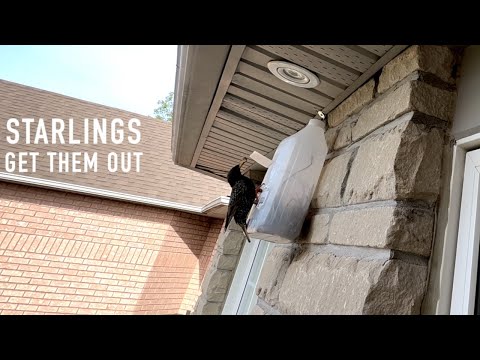 ▶ See our starling procedures
Compassion is not negotiable
A nest is a family.
We treat it that way.
Behind the sounds in your vent may be parents working hard to feed their young. Our responsibility is to protect your home with patience, care and respect for every bird involved.
We inspect the opening and check for young before planning the removal. When babies are present, keeping them accessible to their parents is central to the process. Our specialized release jug helps support that reunion.
After the birds have been safely removed, we address nesting material and protect vulnerable openings with appropriate screening, while allowing the vent to do its job.
Your starling resource
Answers, all in one place.
Learn what to watch for and how a thoughtful plan can protect your home and the birds.
Starling Facts
Starlings
In 1890, 100 starlings were released in New York’s Central Park, by a man who wanted to have all bird species mentioned by William Shakespeare introduced to North America. Since the introduction of this non-native species, their population has grown to what is estimated to be in the hundreds of millions. After pigeons and sparrows, they are the biggest pests that hail from the skies. The following are some more starling facts for Toronto homeowners:
Habitat
Starlings are found throughout North America and Europe and are known for their ability to adapt to urban and suburban environments. As cavity dwellers, they seek out enclosed spaces for nesting, making home exhaust vents and other openings on a house ideal for nesting. Once inside, they build nests to lay eggs and raise their young, often causing blockages and potential hazards.
Breeding
Monogamous, starlings court and mate each spring. Three to eight eggs are hatched in each clutch and birds can nest up to three times a year. Eggs hatch 11 to 13 days after incubation.
Food And Feeding
They eat a variety of substances but prefer insects they can pull out of lawns and grassy fields. When feeding, they tend to flock with birds in the front frequently shifting to the back in a rolling pattern.
Morphology And Lifestyle
- Length: 15, 30 centimeters depending on species
- Weight: 34, 225 grams
- Calls: Varied, can emit a “wolf whistle” like sound along with various whistling notes and chatter
- Lifespan: About three years on average
Did You Know?
- Starling fact: Starlings are very aggressive!
- Starling fact: Slippery droppings pose safety risks in populated areas.
- Starling fact: Starlings compete for resources with native, cavity-nesting birds like purple martins, bluebirds and flickers.
Starling Problems
Birds in Exhaust Vents and Soffits
A variety of starling problems can occur when they decide to nest within exhaust vents and soffits. Starlings pose significant risk to property and can cause health hazards due to their nesting habits and droppings. The following are some common starling problems and some warning signs for you to look out for:
Property Damage
Fire hazards: Starlings nesting in dryer vents can clog the exhaust, restricting airflow and causing lint buildup, which significantly increases the risk of a fire due to overheating.
Odour & Moisture Issues: When starlings block bathroom and stove vents, moist air and grease cannot escape properly, leading to mold growth and damage to walls and ceilings. Their droppings accumulate inside vents, creating strong, unpleasant odors that can spread throughout the home.
Insect Infestation: Starling nests attract feather mites, flies, and other insects, which can invade the home. The presence of decaying nesting materials also encourages bacteria and parasites to thrive inside the vent. Starling droppings on walls, windows, cars, and property are also unsightly, acidic and can be difficult to clean, often leaving behind stains and damage.
Health And Safety Risks
Disease: Histoplasmosis, a fungal respiratory disease, can be caused by bacteria, fungal agents and parasites found in the bird droppings.
Allergies: Starling nests and droppings can release airborne particles, feathers, and dander, which may trigger allergic reactions in sensitive individuals. Exposure can cause sneezing, coughing, watery eyes, and respiratory irritation, especially for those with asthma or other breathing conditions. Additionally, mites and bacteria from starling infestations can further aggravate allergy symptoms and impact indoor air quality.
Fire Hazard: Dryer vents can pose a serious fire risk if birds build nests inside them. Nesting materials like twigs and grass and other debris can block airflow, causing the dryer to overheat and potentially ignite, as these materials are highly flammable.
Starling FAQs
The Following Are Some Common Starling Questions That Our Customers Ask Us:
Do Starlings nest in vents?
Dryer, stove, and bathroom vents are ideal nesting spots for Starlings. A vent with a metal flap may not deter them as Starlings can hover or perch while raising the flap to get into vents. If you have Starlings nesting in your vent, please contact a professional to safely and humanely remove the nest.
Can Starlings nest in walls?
Yes, Starlings will nest in any cavity they can gain access to. It’s also not uncommon for young to fall out of nests and get trapped between walls. If you hear bird chirping in your wall, please contact a professional to safely and humanely remove a starling that may be trapped.
Can Starlings nests be moved?
If there is a Starling nest in a vent, attic or wall that you need to remove, please contact a professional. Only once the eggs have hatched can the nest be relocated to the outside the vent opening. Careful positioning will guarantee that the parent birds will continue to feed their babies.
I have been told that starlings will leave my attic on their own after a few weeks weeks. Is that true?
It is not uncommon for nests to be reused by the same family or a different family or species in the future. It takes trained technicians to identify starlings nests and remove then using humane, hands-on techniques.
We only see one bird going in and out of our attic so there are probably no babies, right?
Not necessarily. Babies can remain in the nest for a period while the mother locates and returns with food. Babies will leave the nest when they are ready to fly.
I’ve been told that you have to catch the starlings and relocate then far away from your house otherwise they will get back in. Is that true?
No. Following our humane removal procedure, we install professional bird proofing in all possible entry points. The starlings will not be able to get back in, we guarantee it!
How do I know if I have starlings in my home or building?
Starlings are usually very noisy and are not very discrete. Babies will be very vocal when calling for food from their mother. And you will be able to see the mother starlings coming and going with food and may even be able to see the open mouths of the babies. Starling droppings are also easy to spot on concentrations around nests and entry points.