



Skunks · At a glance
Share your yard.
Not under your deck.
Skunks look for quiet, sheltered places to raise their young. The space beneath a deck, porch or shed can feel like a safe den, even when it is too close for comfort.
Our family-run team brings 40+ years of hands-on experience to humane skunk removal across Toronto and the GTA.

Where they live
Under decks, porches and sheds, especially in quiet spaces that offer cover.
How they get in
Open edges and gaps beneath structures can give skunks access to a sheltered den.
Signs & damage
Digging near a structure, repeated activity at an opening and a noticeable odour.
There may be kits
An adult coming and going may be caring for young hidden beneath the structure.
See our procedures
Humane removal.
See it in action.
Watch how our team approaches skunk removal from beneath decks, sheds and porches, with care for the animals and your home.
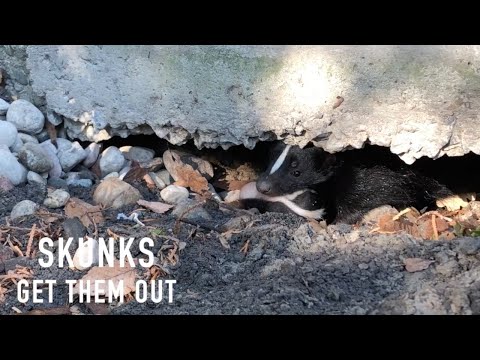 ▶ Watch the skunk removal video
Compassion is not negotiable
Skunks under decks.
A humane way forward.
Every animal deserves to be treated with care. When a skunk finds shelter beneath a deck, we look for the safest way to help the family move on together, especially when kits may be hidden nearby. We take the time to understand where they are and what they need before choosing a humane approach. Compassion guides every step.
Our team assesses the den, keeps mothers and young together, and uses humane exclusion methods when it is safe to do so. We then protect the opening to help keep the space beneath your structure from becoming another den.
We offer on-site assessments, humane removal and repairs to help you feel comfortable in your yard again.
Your skunk resource
Answers, all in one place.
Explore the facts, learn what to watch for and find answers to common questions.
Skunk Facts
Everything You Need To Know About Skunks
Skunks are renowned for the horrible smell they emit when injured, frightened or mating. The odour can remain on pets and in ventilation systems for weeks or months. But these animals can also cause significant damage to buildings and landscaping. They are opportunistic animals that thrive in a diversity of habitats throughout North America. The following are some more skunk facts for Toronto homeowners:
Habitat
Underneath structures: Skunks are burrowers. In the wild they will dig into the ground at the base of a tree. In urban settings, they can be found underneath decks, sheds, porches, houses and other solid foundations. Once underneath, they will hollow out a bowl-shaped depression lined with grass and leaves.
Breeding
Early in the year: Skunks mate between January and mid March. Interestingly, female skunks can store the male’s sperm separately from her eggs in order to delay pregnancy until weather conditions are favorable. The gestation period is around 63 days long.
Litter size: Female skunks produce litters between 4 and 6 offspring (but it can range between 1 and 9).
Rearing: Baby skunks keep their eyes closed for the first 21 days and remain in the den for the first 6 to 8 weeks. After this time, the young will venture out for nighttime foraging with their mother.
Sexual maturity: Skunks are sexually mature after 9 to 12 months.
Food And Feeding
Time of day: Skunks are nocturnal and will venture out to forage most evenings.
Diet: Skunks are omnivores but prefer to eat plants, veggies, fruits, insects, grubs, small animals and eggs as well as anything left in accessible garbage cans.
Morphology And Lifestyle
- Body length: 10-15 in
- Tail length: 10-15 in
- Weight: 1, 4 kg
- Vocalization: Usually silent but can produce a bird-like noise
- Lifespan: Between 5 and 10 years
Did You Know?
- Skunk fact: Skunks can spray their scent glands up to 15 feet.
- Skunk fact: The skunk smell can remain on skin and pet hair for days, weeks and even months.
- Skunk fact: Skunks have poor eyesight and as such, their awareness of their surroundings is limited.
- Skunk fact: Skunk burrows can cause structural weakness in decks, porches, sheds and foundations.
- Skunk fact: Skunks will dig up lawns and gardens to find food.
- Skunk fact: Skunks can carry the rabies virus and not “look” infected.
Skunk Problems
A variety of skunk problems can occur when they decide to nest within a residential or commercial structure. The most obvious problem is their incredibly noxious smell. If sprayed onto buildings or surfaces, the odour can remain for weeks or even months in high enough concentrations. But the smell is actually of lesser concern when compared to some of the property damage and health risks these animals can cause. The following are some other common skunk problems and some warning signs for you to look out for:
Property Damage
Burrowing under foundations: In the wild, skunks burrow underneath the base of trees. However in urban settings, they will burrow underneath solid foundations which can cause thousands of dollars in damage should structural elements shift or crack.
Chewing: If necessary, skunks will chew through wood and siding to make their burrows.
Lawns and gardens: Aside from garbage, skunks eat a lot of insects and grubs. It is not uncommon for skunks to dig up gardens and lawns in their search for food.
Health And Safety Risks
Rabies: Skunks have been known to carry and transmit the rabies virus. The proportion of skunks with rabies is greater than that seen in fox or raccoon populations which is why this is of concern. Infected skunks cannot be distinguished from healthy skunks so any possible contact with skunk saliva should be taken very seriously.
Noxious spray: Aside from the smell, the skunk spray can cause nausea, vomiting and even blindness because it contains sulphuric acid.
Skunk FAQs
Frequently Asked Skunk Questions That Our Customers Ask Us:
I have been told that skunks will leave on their own after 6, 8 weeks. Is that true?
No. The skunks may leave at some point but most often they will return to other den as long as it is accessible throughout the year. The only way to ensure they are permanently excluded is to use humane removal techniques and to install professional skunk proofing.
There is only one skunk going in and out of the den so there are probably no babies, right?
Not necessarily. Skunk babies remain in the den for 6, 8 weeks after they are born. And then they only venture our with their mother in the evening to forage. It takes trained technicians to identify if there are any babies present and to use humane, hands-on techniques to remove them.
I’ve been told that you have to catch the skunks and relocate them far away from your house otherwise they will dig back in. Is that true?
No. Following our humane removal procedure, we install professional skunk proofing in all possible entry points. The skunks will not be able to dig back in, we guarantee it! In fact, if a skunk does manage to dig back into your home, we will return and complete the process again for free.
How do I know if I have skunks underneath my home or building?
More often than not, you will have smelled them. But in some cases, the smell is not immediately apparent in which case you should look for digging and damage to your lawn and garden.